Gallery review · London
This Is Still Not a Pipe: The Afterlife of Magritte
Gagosian, Grosvenor Hill · September 24–December 12, 2026
René Magritte spent a career insisting that an image of a thing is not the thing, and Gagosian's London survey makes a persuasive case that the lesson never stopped spreading. Organized with the Fondation Magritte and curated by Jasper Sharp and Bernard Lagrange, the exhibition sets more than fifty Magrittes beside work by roughly forty-five artists who came after him. It is the rare blue-chip group show with real scholarly spine, and one of the strongest things on view in Mayfair this autumn.
The timing is deliberate. The show marks twenty years since Magritte and Contemporary Art: The Treachery of Images at LACMA, and ninety years since the 1936 International Surrealist Exhibition at the New Burlington Galleries, a short walk from the gallery's Grosvenor Hill doors. London has hosted this argument before. Here it is picked up again.
The Magrittes
The loans, from museums and private collections, are the reason to go. The sequence runs from Les Fleurs du voyage (1926), the earliest painting on view, through L'Ombre céleste (1927) and Le Parfum de l'abîme (1928), once owned by André Breton, to La Malédiction (1931), his first canvas given entirely to a cloud-filled sky. La Lampe philosophique (1936), the nose curving into the pipe of a conceptual self-portrait, anchors the later rooms. L'Empire des lumières (1961), lent by the Heidi Horten Collection, supplies the day-and-night landscape everyone half-remembers.
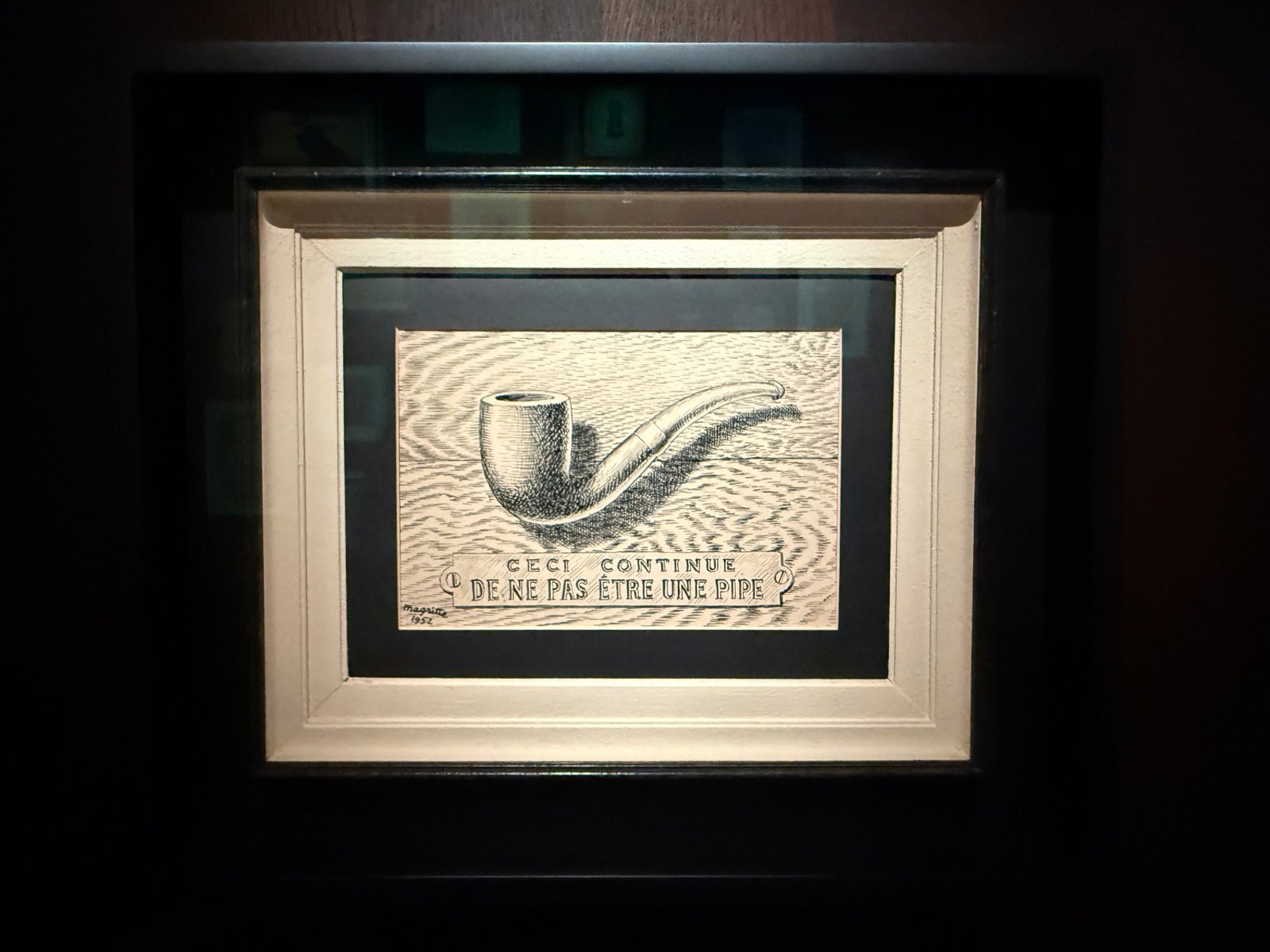
What distinguishes the selection is range. Three canvases from the deliberately crude vache period of 1948 show Magritte at his least polite, and the 1952 La Trahison des images. Ceci continue de ne pas être une pipe gives the exhibition its title and its joke: the pipe is still not a pipe, now with an added "continues." Works on paper, including drawings that run from technically assured to openly ribald, round out a Magritte who is wittier and more varied than the bowler-hat shorthand suggests. It is not a full retrospective, and the advertising work and wartime Renoir period are absent, but it is a generous portrait.
The afterlife
The contemporary pairings are where the show earns its title, and where it is least even. The best are witty and exact. George Condo's The Apple Picker (2009), its figure's head replaced by an apple, answers Magritte's balloon-headed man in L'art de vivre (1967). Michael Craig-Martin's An Oak Tree (1973), a glass of water on a glass shelf, is the clearest conceptual cousin of the pipe. Betye Saar's Window of Sirens and a David Hammons work built from tiny zippers join Magritte's compartmentalized Le Musée d'une nuit in a quietly rigorous trio. In the reception room, which holds no Magrittes at all, Alex Da Corte's three-legged Streetlamp for Drunk (2018) conjures the lamp-post of L'Empire des lumières without borrowing a brushstroke.
Some links are looser. A shared object, a pipe in a self-portrait or a cloud, can stand in for a real conversation, and a few drawings and an AI-generated print are hard to connect to Magritte at all. That is the cost of a thesis this broad, and it is a fair one. The exhibition makes the stronger claim that Magritte's habits (the deadpan caption, the ordinary object made strange) are now part of the common language of art, with Sarah Lucas, Dana Schutz, Jeff Koons and Yoko Ono, whose Sky TV (1966) was made in his lifetime, all speaking it differently.
The installation
Across four softly lit rooms the hang resists the obvious chronological march. Room two and room four share a layout, a wide, low plinth carrying sculpture, in black and brick respectively, with paintings above. Koons's stainless-steel Jim Beam – J.B. Turner Train (1986) runs the length of one, and Magritte's own sculpture and even his hat and suitcase sit among the guests. The third room packs some twenty-five works onto a single wall, roughly half of them Magrittes, a dense salon that rewards slow looking. The effect is calm rather than crowded, which is no small feat given the number of famous images in play.
Verdict
A show of this ambition can feel like an argument made by accumulation. This one holds together because the Magrittes are strong enough to carry the weaker pairings, and the best pairings sharpen how we look at him. For collectors and advisors, it is also a useful lesson in how an artist's market and influence are built: not by imitation, but by the objects and ideas others cannot stop borrowing.
Visit: This Is Still Not a Pipe: The Afterlife of Magritte runs through December 12, 2026, at Gagosian, 20 Grosvenor Hill, London, Tuesday to Saturday, 10am to 6pm. Admission is free, and a fully illustrated catalogue accompanies the exhibition.