Essay
The Flat and the Felt: Katz after Matisse
Flatness is the oldest complaint made against Matisse and the newest compliment paid to Alex Katz. In both cases the complaint misses the point. Neither painter flattens a picture to drain it. Each flattens it so that one decision, a field of color or a clean edge, reaches the viewer all at once, and the feeling arrives before the description does.
This essay sets the two side by side. Matisse makes the argument that a flat plane of color can carry feeling. Katz, born in 1927, inherits that argument and moves it into a later century: faster, larger, cooler and more public. They share a conviction that surface is not the opposite of depth. What separates them is what each wants the surface to do.
Matisse: color as architecture
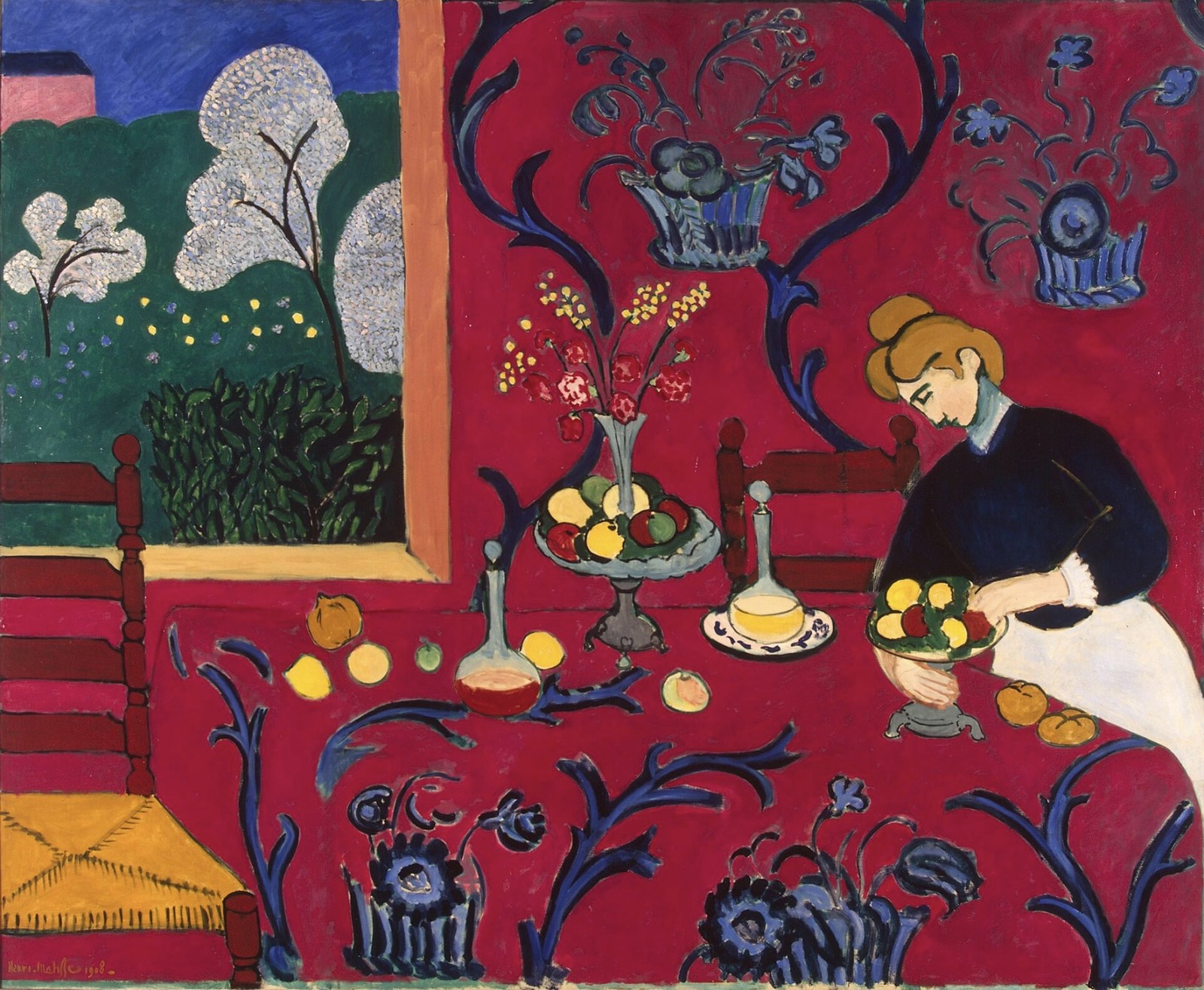
In Harmony in Red (1908), now in the Hermitage, a saturated red covers both tablecloth and wall. A vine arabesque runs across the two without a clear break, so the table and the wall read as one field and the background moves forward. The window at upper left is painted so flatly that it looks less like a view than a picture of a garden. Matisse keeps some depth: the chair and table recede, and the dishes mix frontal and overhead views. The flatness is argued with, not assumed.
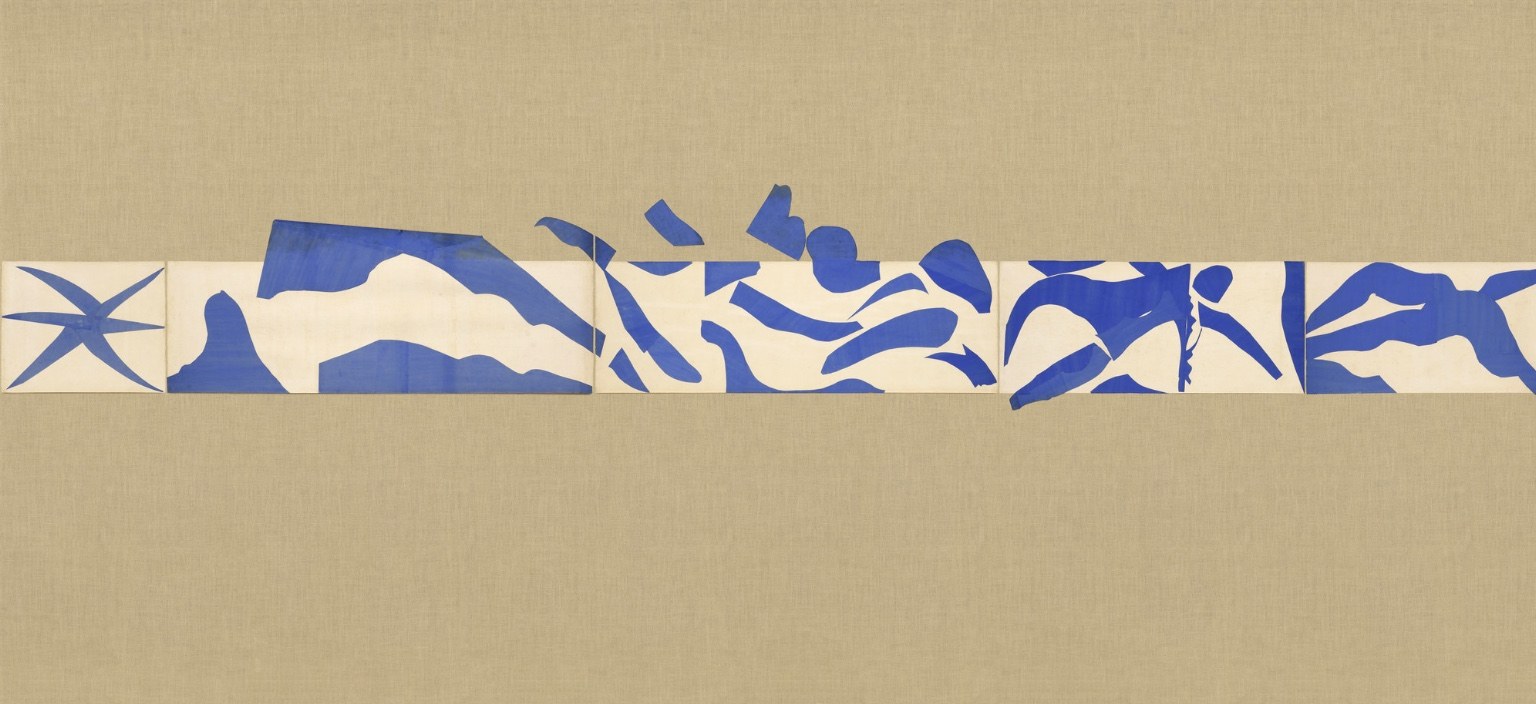
About forty years later he took the idea to its limit. From the late 1940s Matisse worked almost exclusively in cut paper, cutting sheets painted with gouache and arranging the shapes into compositions that grew from small works to mural-sized and room-sized pieces. The Swimming Pool (1952) was made for a single room, his dining room in Nice. Color is no longer applied to a form. Color is the form. MoMA's 2014 to 2015 exhibition gathered about one hundred of these works, the largest presentation of them to date.
Katz: a slow inheritance
Katz came to Matisse gradually. In his last year at Cooper Union a teacher sent him to a Matisse exhibition at the Pierre Matisse Gallery. He was astonished by how well the older painter painted, and by his own account it took about three years to fully appreciate what he had seen. What he admired was economy: many spatial moves made at once, in thin paint, with a result that looks effortless. He later learned how much Matisse rehearsed beforehand, which surprised him.
The debt shows in the work. Katz made his first collages in 1955 and began painting cutout figures on wood in 1959, portraits cut along their contours and set into real space. The Albertina notes that these may refer to the cutouts of Matisse and Picasso, and that from the 1980s Katz studied the staying power of Matisse's homogeneous color fields as a replacement for detail and modeling. Flatness was a deliberate direction. Katz has said that in the early 1950s he painted from photographs because they were flat, and that flatness seemed the way to something new.
Two ways of flattening
Matisse flattens with pattern and warmth. The arabesque, the saturated room and the cut shape all pull the eye across the surface and keep it there, inside an interior that feels lived in. Katz flattens with the photograph and the billboard. He crops a face, enlarges it, and sets it against an even ground that, in the Albertina's phrasing, pushes the zoomed-in head toward the viewer. He has said he cannot think of anything more exciting than the surface of things, just appearance.
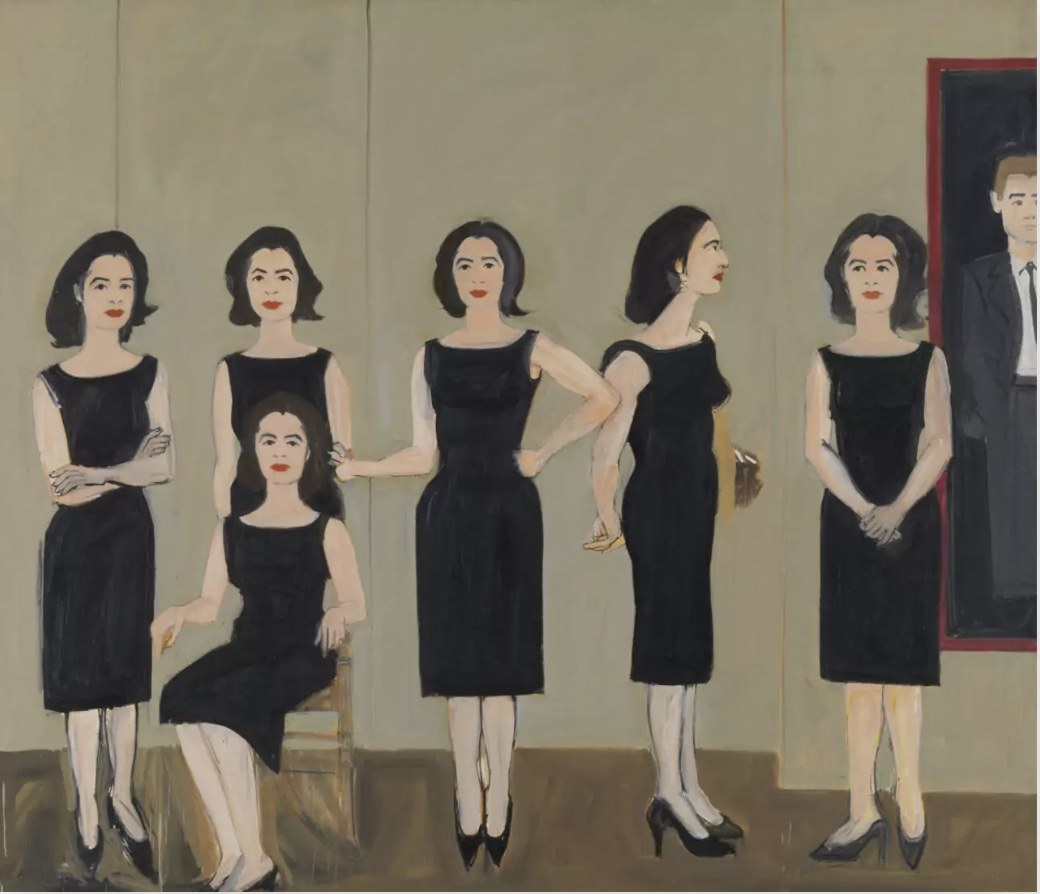
The pictures of his wife Ada show the method. He met her in 1957 and married her in 1958, and she became his most frequent subject. The Black Dress (1960) shows one figure from several viewpoints, and Red Smile (1963), a close-up of her face, is nearly ten feet wide with a broad flat red field behind it. Scale is part of the argument. In the 1960s Katz moved to billboard-size pictures, and in 1977 he installed twenty-three billboard-style heads in Times Square. Matisse's surface invites you into a room. Katz's puts a face in front of you. That is my reading of the difference, and it is also the difference between a studio interior and a city street.

The felt: near and far
Flat does not mean thin in feeling, and the paint explains why. Katz works wet on wet, so color shifts as he pulls paint through the layers beneath it. A black stroke can turn to grays, which means the underlayers have to be controlled with precision. He also works up large pictures from small studies, and he describes enlarging a study only when he “felt I had it.” The word is exact. The picture has to feel right before it is allowed to get bigger.
Matisse worked the same way in a different key. His economy of thin paint and rehearsed placement is what Katz admired, and it is why the cut shapes look inevitable. From across a room both painters register as a single image: a red, a face, a leaf. Up close the thin, deliberate handling holds. This is the old collector's test, whether a picture survives the hundredth look, and flat pictures are often the ones that pass it, because nothing in them is hiding.
What a collector can take from this
The comparison gives a way to look at any flat picture, and it works well at a gallery or a fair:
- Check the edges. In a good flat picture every edge is a decision. Look for the one that was reconsidered.
- Test it at two distances. Read it from across the room, then from a foot away. The color should carry at both.
- Ask what the flatness is for. Matisse flattens to hold a room together. Katz flattens to bring a face forward. If you cannot say what the flatness is doing, it may only be flat.
Matisse and Katz are nearly sixty years apart in birth and a good deal further in temperament. The line between them is still easy to follow, and it runs through the surface.
Sources
- Alex Katz with Phong Bui, The Brooklyn Rail, May 2009
- Alex Katz Paintings, Bio, Ideas, The Art Story
- Alex Katz, Albertina press release, 2023
- Henri Matisse, Harmony in Red, course text
- Henri Matisse: The Cut-Outs, MoMA, October 12, 2014 to February 10, 2015